 An effective way of viewing Aikido is as a system of reflex control. Erik Riker and I have been studying reflex controls for the last few years. We first discovered structural reflexes by studying videos by Kanshu Sunadomari. I had been exposed to these earlier but did not understand how they worked. These are reflexes that organize our muscles so that our bodies can perform mechanically. These reflexes maintain a particular balance between muscles. We disrupt that balance. When the balance is disrupted Uke becomes weak. The Unbendable Arm exercise demonstrates this. In that exercise Nage disrupts Uke’s muscle balance in such a way that Uke’s body does not realize it is unbalanced and Uke becomes weak.
We normally use these muscle imbalances to cause Uke to fall down. In this case Uke’s body will sense the imbalance and quickly correct. Because of this the technique must be applied at normal reflex speed. In Aikido we cause a rotation about the vertical axis of the torso and/or an arm rotation along with extending Uke out and then dropping Uke. Video’s of everything discussed here are in my YouTube channel, Survival Aikido. For example when executing Kote Gaeshi Nage might tenkan beside Uke and then step back pulling Uke’s arm. This rotates Uke about a vertical axis. The slight forearm rotation increases the muscle imbalance and Uke’s arm is slightly extended. Then Uke’s hand is taken to the floor causing Uke to fall. Done properly pain is not a factor. If pain is involved then Nage cannot determine the effectiveness of the reflex control.
We discovered the second reflex control in a different way. Much of our practice is with padded training weapons, particularly knives. Uke attacks with commitment and really tries to touch Nage with the training knife. This type training is too dangerous with a wooden tool so the padded tools are necessary. We determined that just pivoting out of the way as done in basic Aikido would not reliably prevent Nage from getting stabbed. This was true even when Uke did not know to which side Nage would move or what Nage would do.
The basic Irimi exercise where Uke raises the boken and attacks with Shomen Uchi while Nage enters with Tsuki has always bothered me. I reasoned that if Shomen Uchi can be so easily defeated then no one could use it. In spite of this Shomen Uchi has been used for thousands of years. I wanted to know the counter to Irimi. I found a video of Saito countering Irimi by raising his boken and then pivoting out of the way of the Tsuki. I thought this was phony because our experience was that pivoting out of the way would not work if Uke was alert. We tried the pivot as Saito had done and it did work. We knew we had just discovered something very important and started trying to understand what was happening.
A few months later a friend gave me the book, “Systema, No Contact Combat” by Vartan Mamiko, that explained the reflex. Humans have a grasping reflex. When we reach for something or strike at something a reflex takes over to complete the task and we lose most conscious control. This is a very primitive reflex that may be present in every species. Even the most primitive. This is why a bull fighter can redirect the bull to follow the cape rather than the matador’s body. The swordsman’s pivot works because the raised sword draws Nage’s attention and the Tsuki does not follow Uke’s body. O’Sensei shows this repeatedly in demonstrations. No Contact Systema uses this principle in a different way from O’Sensei. I think O’Sensei discovered this reflex as a general principle and it is a basis of his Aikido.
This is not fundamentally different than leading Uke when Uke reaches for Nage’s wrist. When Uke strikes at Nage with Tsuki, if Nage’s hand can grab Uke’s attention, then Nage can get the strike to follow Nage’s hand rather than Nage’s body. Now Nage is a Matador.
There are fairly strict requirements that must be met to get this to work. It is easy to do something that looks like the right thing but not get the necessary effect. This principle works best when Nage moves as Uke is at the distance we normally practice. Where Uke’s and Nage’s weapons do not quite touch. Once this principle is applied the basic Aikido exercises that seemed so impossible start working. The further we have gone with this the more convinced we have become that the exercises chosen for Aikido are mostly exercises that teach these reflex or mind control principles.
Controlling the reaching reflex is useful for circular attacks and grabbing attacks as well as Tsuki. If is much less interesting where Uke reaches for a wrist if Nage does not redirect the attack. For this reason those attacks do not show the tremendous power of the method. It is important to realize that until Uke attacks there is no reaching reflex to control. If Uke just stands there and does not strike there is nothing to lead. It is also important to note that once the punch finishes the reflex turns off and the mind control ends. A good Uke will then continue with another attack unless Nage has established another control. It should also be noted that controlling the striking reflex also breaks Uke’s structure activating the structural reflexes to Nage’s advantage.
The third category of reflexes that are important are defensive reflexes. We have experimented extensively with the startle reflex. In the startle reflex Nage threatens Uke. This causes Uke to take defensive action that Nage can use against Uke. This also disrupts Uke’s structure. We find the defensive reflexes most useful in freestyle when we are close to Uke. This would be more like a Karate fighting distance. This happens frequently because the second Uke tries to get Nage while the first Uke is being thrown.
Controlling both the striking and defending reflexes involves getting Uke’s attention so both involve reaching towards Uke’s face. This means that Nage can always start the same way giving the same initial response. The three reflexes discussed here are fundamental to the Aikido practiced by O’Sensei. Once aware of the reflex controls it is obvious what O’Sensei is doing. There are other reflexes we are studying but these give a good start to learning reflex control. Controlling these reflexes makes Aikido an exercise in mind control.
by John Kilpatrick, Okolona Aikido
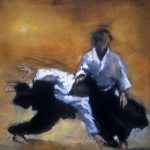 Harvey Konigsberg was born in New York City in 1940. He studied painting at New York University and the University of Miami. In 1965, he began studying Aikido with Yamada Sensei at the New York Aikikai. He devoted himself equally to the disciplines of painting and Aikido. In 1987, he founded Woodstock Aikido and continues to serve as chief instructor. He is currently a seventh degree black belt and a Shihan, master instructor. Over the years, his paintings have been exhibited in 22 one-man shows in New York City and in numerous national exhibitions. Hand-signed, limited edition archival prints, as well as t-shirts featuring his aikido art work, are available for sale at his online store,
  At my first USAF Summer Camp, I have a singular experience. Instructors create a groundwork of training, and elicit spiritual development on a collective level. As fellow practitioners, we initiate each other with hard skill but exude tenderness. I bring back both learning and a bond of presence to my home dojo. Here I share impressions of the merciful correction I received.
 How was your day? It’s almost as generic a question as “How are you?” but it’s nonetheless an important question. It can be answered with “good,” “okay,” or “bad” (or with other more detailed answers). The same is true for “How was your (Aikido) class?” The answers to these questions differ day-to-day, and class-to-class. These differences are important since a lot can be learned from the varying experiences of your different days and classes. A truly good day feels significantly better right after a horridly bad day. A day of novelty brings new excitement after a long series of routine days. We may go through several days with little memory of them because they are just so ordinary, but that doesn’t mean they aren’t important. They add up and one day we may look back on them with a feeling of nostalgia. Something that may not seem important today may be exponentially more important a year from now. Something that is urgent now may seem so irrelevant in the future. The contrasting days of our lives give us a series of mental tableaus to enrich our experience of this world.
 There’s a point in the technique where you can feel uke’s weight or resistance. You think you can’t go any further and feel as though uke has stopped you there in the middle of your movement. However it just so happens you are training with a sempai who directs you to move a little further to make the technique more effective. Sometimes just a little extra extension is all it takes. You were trying to be relaxed while doing the technique, but in fact made some parts of your body dead weight instead. There is a big difference between being relaxed and being limp. You can still be relaxed while having energy extend throughout your movements. That added energy is just the bit you need to extend upward for that Kokyuho or create a sharper cut down for that Ikkyo. When you’re at a point where you feel like you’ve hit a dead end, give it a little more energy and see where that takes you.
 A soft shuffle of barefoot students draws attention to the peaceful silence soon to envelop the practice space we call Dojo. As if by magic, the wave of people dressed in white uniforms find their spots as they slowly line-up in a sitting position called Seiza. And in a moment, all time seems to pause. Like breath, this is a suspension of thoughts, a way to call back one’s mental activity to the present moment and the space which one occupies. In this moment of recollection, all becomes unified. The state of calm ensues and invites new learning. Oftentimes announced by a clap, then another, then a third, the line of students bow, synchronized by an inner rhythm acquired through the practice of awareness and presence. Thus, practice begins.
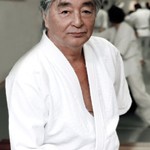 It has been many months since I wrote an article to the Aikido community, and that is actually good news because I have been back to my busy schedule traveling and teaching all over the world. I am happy to be taking these few days at my own dojo because right after USAF summer camp I traveled immediately to camp in Germany, and I leave soon for a trip to Brazil, Argentina and Chile. So it’s always nice to be home, no matter how short! I would like to thank everyone who came to camp this year, both Osawa Sensei and I had wonderful week.
 Test applications received and dated between January 2nd 2017 and May 31st, 2017 (some listings represent applications prior to Hombu approval, applications not received by posting date will not be listed in the post).
  You’re sitting there. Your legs hurt after a bunch of suwari-waza. The instructor demonstrates a technique, and you can tell there’s some subtlety to it. He shows it 3 times, pronounces its name, and says “Ok, partners”… and there you are, left mainly to your own devices.
 Once again,